
Recap of the impact of DOCOMOMO Journal in 2025
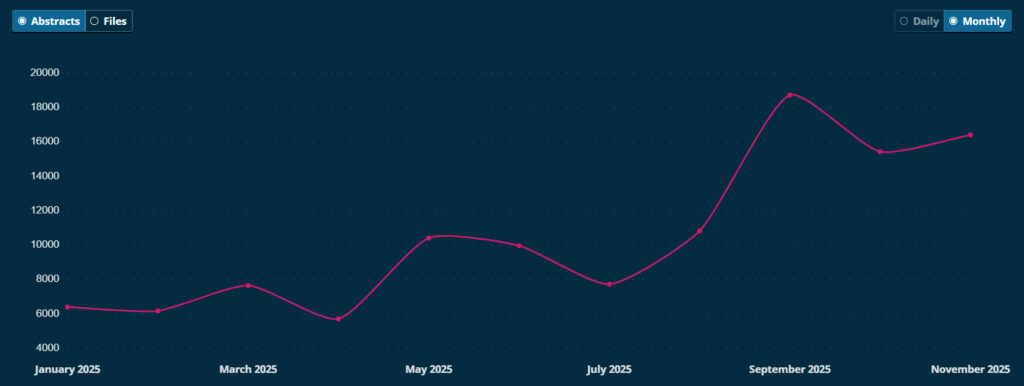
Overview abstract views from OJS (Jan-Nov 2025)

Most viewed abstracts in 2025 (January-November):

Lico Rising from of the Ashes: post-war Philippines Architecture
Toye Examining the Recorded Histories of Nigeria’s First Post-Independence Universities
Uduku et al. Buildings for Higher Education in Africa
Sopandi The Nature of Tropical Architecture in Indonesian Modernism
Oginni et al. Documenting the Reuse of Modern Buildings: An appraisal of a 2022 British Academy writing workshop of postgraduate students and researchers
Kwabi A Tropical Modern Architect: Prof. John Owusu Addo
Damir et al. Sites of Modern Industrial Heritage in Egypt and Iran: Local, National, and International Relevance for Conservation and Reuse
Radovic Mahecic Juraj Neidhardt’s early work: Archiepiscopal Boys´ Seminary in Zagreb (1925-1929)
Sopandi et al. Modern Architecture in Southeast Asia, an Introduction. Asia, North-South-West-East
Maeda et al. The real reason why Nakagin Capsule Tower was never metabolized
Harrison et al. African Agency and Colonial Committees at Fourah Bay College : Architecture and planning of the new Fourah Bay College in Freetown, Sierra Leone
Codjoe et al. Reflections on the Impact of Tropical Modernism on African Primary Schools: A comparison of two schools in Sub-Saharan Africa
Shevchenko MASS HOUSING IN UKRAINE IN THE SECOND HALF OF THE 20TH CENTURY
Girard Religious Tropical Architecture: the churches of Leandro V. Locsin in the Philippines
Fleming et al. Recovering the Historical Construction and Materials of Erik Gunnar Asplund’s Stockholm Public Library
Klemp Dieter Rams: Ethics and Modern Philosophy. What Legacy Today?
Caldenby Kollektivhus: the Swedish model
Loan et al. Modern Architecture in Vietnam or Vietnamese Modern Architecture?
Vittorini Reconstructing housing and communities: the INA-Casa Plan
Ivković et al. International Conference Centre and Nile Hotel: A faint memory of past geopolitical alliances and ideals in Kampala, Uganda

Congrats to all contributors to DOCOMOMO Journal: thank you authors, thank you reviewers, thank you guest editors!

In 2025, the DOCOMOMO Journal has grown again, or should we say that the use of the journal has grown? In 2025, we published two special issues, just like previous years. As can be seen in the graph, the number of visits to our Open Access journal website has grown tremendously. In the beginning of the year there was a steady number of 6000 viewed abstracts per month. September peaked above 18000. Not only were the abstract pages visited, also many people continued downloading the full articles; up to 14000 in the final months of the year; several individual papers were even downloaded more than 1500 times each.

From issue 42 (2010) onwards, all contributions to DOCOMOMO Journal can be individually traced and referred to through a DOI. We cannot credit enough Ana Tostões (former chair of DOCOMOMO International and former editor-in-chief of DOCOMOMO Journal) for initiating the Open Access online version of DOCOMOMO Journal! From the Delft-perspective we are very glad to see that amongst the top 20 downloads in 2025 of contributions to the journal, 11 are from issues that were produced from 2022 onwards, under our current mandate.
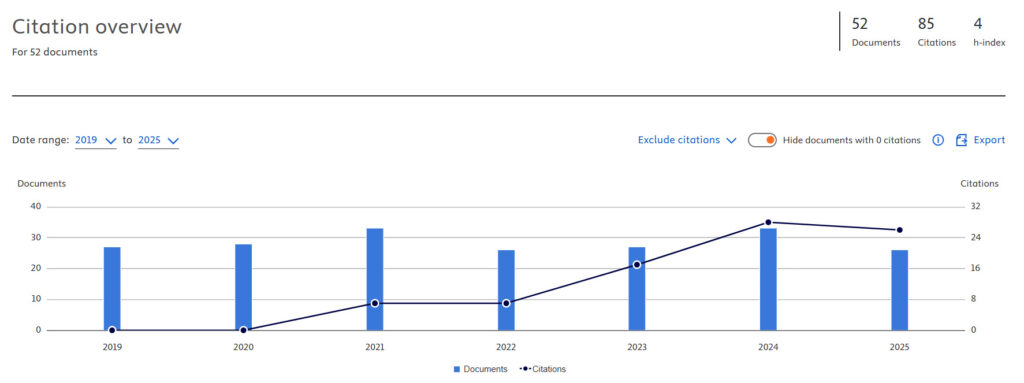
Citation overview Docomomo Journal from SCOPUS (Dec 18, 2025)

Although there is room for improvement, since it’s indexing in SCOPUS in 2018, the number of citations and consequently the h-index of the journal is going up.  The rising number of citations, the number of downloads and the likes on social media of newly published articles are a great sign that DOCOMOMO Journal takes an important and relevant position in the academic, professional and educational practice.

Thank you DOCOMOMO Journal readers!

Wido Quist & Uta Pottgiesser
www.docomomojournal.com